
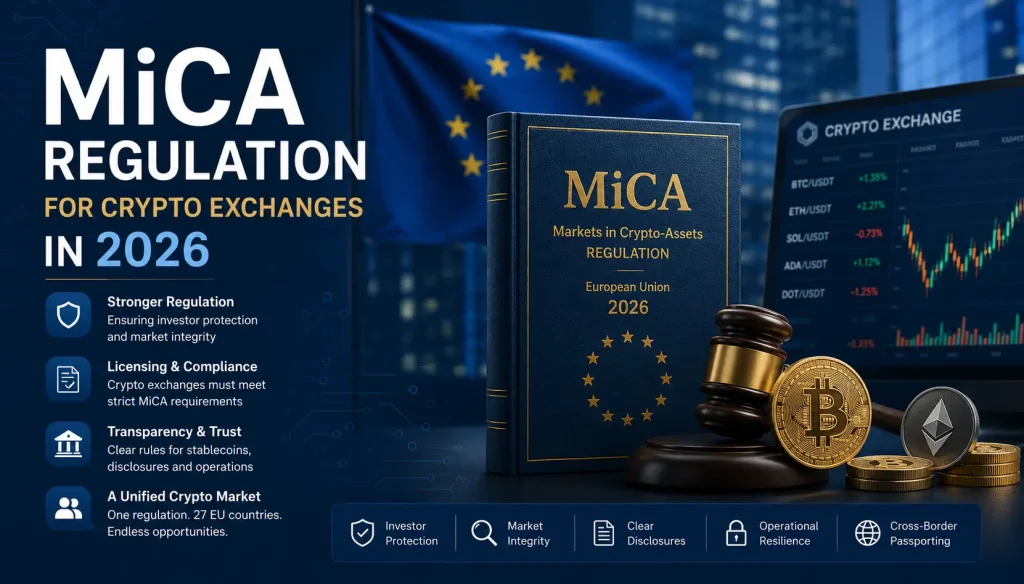
The Markets in Crypto-Assets Regulation (MiCA) represents a landmark development in cryptocurrency regulation, establishing uniform rules across the European Union for crypto exchanges and service providers. As the MiCA Regulation for Crypto Exchanges continues to reshape the digital asset landscape, understanding its requirements has become essential for businesses operating in this space. This comprehensive framework provides legal certainty for crypto-asset issuers, trading platforms, and custodian wallet providers while ensuring robust consumer protection and financial stability throughout the EU.
The implementation of MiCA Regulation for Crypto Exchanges has transformed the European digital asset landscape by establishing uniform standards that address critical operational challenges. Among the most significant improvements is the reduction of transaction delays. MiCA-compliant platforms leverage standardised processes and robust infrastructure to deliver faster, more reliable transaction processing across the European Union.
What is the MiCA Regulation?
The Markets in Crypto-Assets Regulation, officially known as Regulation (EU) 2023/1114, is a comprehensive regulatory framework adopted by the European Parliament on 31 May 2023. This regulation establishes harmonised rules for crypto-assets that fall outside existing financial services legislation, creating a unified approach across all EU member states.
The MiCA Compliant Crypto Exchanges aim to achieve several critical objectives: providing legal certainty for market participants, establishing robust consumer protection measures, and supporting market integrity and financial stability through comprehensive oversight mechanisms.
Cryptocurrency Transaction Policies, Regulations, and Legal Standards
Crypto exchanges operating within the EU must comply with extensive requirements under MiCA, thereby introducing standards comparable to those of traditional financial institutions.
Authorization and Licensing Requirements
Under MiCA, crypto exchanges must obtain authorisation from the relevant national competent authorities before offering services. The regulation introduces MiCA-compliant services as a new standard, requiring exchanges to demonstrate adequate organisational structure, governance arrangements, and risk management systems. Authorisation covers operating trading platforms, exchanging crypto-assets for fiat currency, and providing custody services.
Once authorised in one EU member state, crypto exchanges benefit from passporting rights, allowing them to offer services throughout the entire European Union without requiring separate authorisations in each jurisdiction.
Operational and Conduct Requirements
MiCA imposes stringent operational standards on crypto exchanges to ensure market integrity and customer protection:
- Maintaining detailed order books and transaction records in standardised formats
- Implementing comprehensive customer due diligence and anti-money laundering procedures
- Establishing transparent fee structures and clearly communicating all costs to clients
- Segregating client assets from the exchange’s own funds
- Implementing robust conflict of interest policies
- Providing clear information about risks associated with crypto-asset investments
- Establishing effective complaint handling mechanisms and dispute resolution procedures
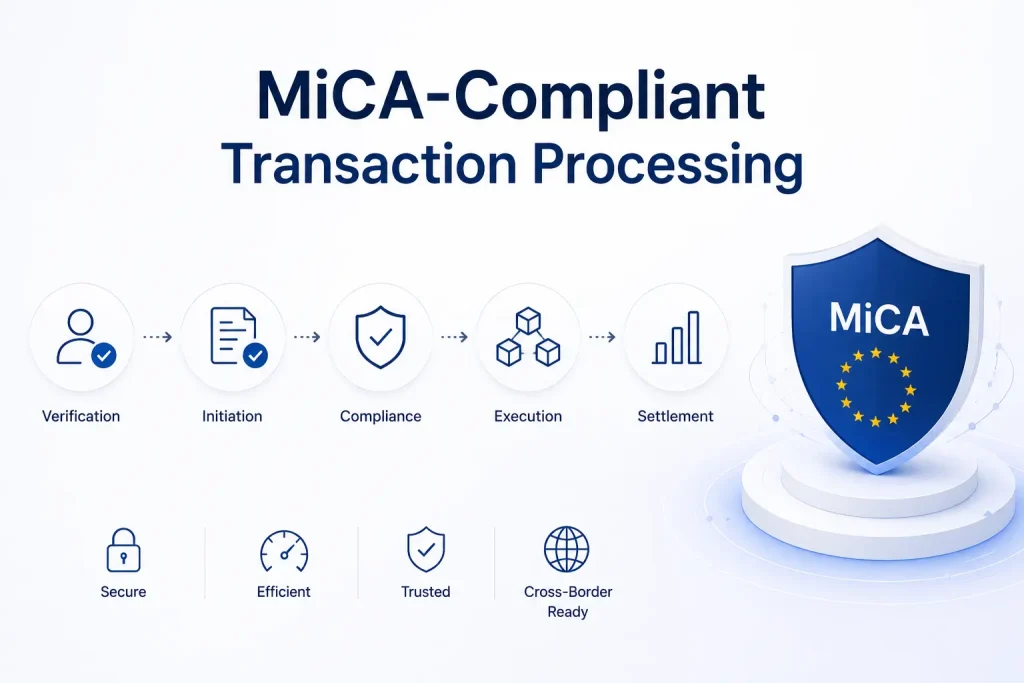
How MiCA-Compliant Services Streamline Transaction Processing
MiCA-compliant services implement harmonized requirements that eliminate jurisdictional fragmentation across the EU. By establishing uniform authorization criteria and operational protocols, MiCA enables platforms to process transactions through standardized pipelines, reducing redundant verification steps and allowing automated compliance checks that previously required manual intervention.
Real-Time Exchange Rate Integration
Platforms adhering to MiCA standards integrate real-time exchange rate feeds from authorized providers, ensuring transparent and immediate conversion rates. This eliminates delays associated with manual rate calculations and reduces price slippage during conversions.
Automated Compliance Workflows
MiCA-compliant platforms leverage automated KYC verification, transaction monitoring, and risk assessment tools that meet regulatory standards while minimizing processing time. These systems enable near-instantaneous compliance checks that previously required hours or days.
Key Features: Reducing Transaction Times
| Feature | Traditional Platform | MiCA-Compliant Platform |
| Authorization Process | Multiple jurisdictional approvals | Single EU-wide authorization |
| KYC Verification | Manual review (1-3 days) | Automated verification (minutes) |
| Cross-Border Settlements | 2-5 business days | Same-day or instant |
| Compliance Checks | Sequential manual reviews | Parallel automated processing |
Benefits for Crypto-to-Fiat Conversions
- Instant or same-day settlement for fiat withdrawals to linked bank accounts
- Real-time crypto debit card funding for immediate spending capability
- Reduced slippage through optimized liquidity pools and market access
- Transparent fee structures that eliminate hidden delays from pricing uncertainty
- Passporting rights enabling seamless cross-border operations without additional authorization delays

MiCA Compliance Strategies for Crypto Exchanges
Successfully navigating MiCA requirements demands comprehensive compliance strategies addressing legal, technical, and operational dimensions.
Building Compliance Infrastructure
Establishing a robust compliance infrastructure represents a fundamental requirement for MiCA adherence. Key steps include:
- Conduct a comprehensive gap analysis comparing current operations against MiCA requirements
- Develop a detailed compliance roadmap with specific milestones and resource allocations
- Implement technical systems for regulatory reporting and record-keeping
- Establish governance structures with clear accountability for compliance functions
- Create comprehensive policies and procedures covering all MiCA requirements
- Develop training programs for staff on MiCA obligations
Frequently Asked Questions
What is the MiCA Regulation for Crypto Exchanges?
The MiCA Regulation for Crypto Exchanges is the EU’s comprehensive regulatory framework (Regulation 2023/1114) that establishes uniform rules for crypto-asset service providers. It requires exchanges to obtain authorisation, maintain minimum capital, implement operational standards, and ensure customer protection measures to operate legally within the EU.
When did MiCA requirements become mandatory for crypto exchanges?
MiCA was implemented in two phases. The first phase for stablecoins became effective on 30 June 2024. The second phase, covering other crypto-assets and service providers, became applicable on 30 December 2024. Transitional arrangements allow existing exchanges time to achieve full compliance.
What are MiCA-compliant services?
MiCA Compliant services refer to crypto-asset services that meet all regulatory requirements under the framework, including obtaining proper authorisation, maintaining minimum capital, implementing customer protection measures, establishing transparent procedures, segregating client assets, and adhering to disclosure obligations for legal operation throughout the EU.
Do crypto exchanges need a license in every EU country?
No. MiCA introduces passporting rights, meaning that once a crypto exchange obtains authorisation in one EU member state, it can offer services across the entire European Union without requiring separate licenses in each jurisdiction, significantly simplifying cross-border operations.
What happens to exchanges that don’t comply with MiCA?
Non-compliant crypto exchanges face significant consequences, including prohibitions on offering services within the EU, financial penalties imposed by national competent authorities, and potential criminal sanctions for serious violations. Non-compliant exchanges may be excluded from the EU market entirely.
How does the MiCA license 2026 framework differ from current requirements?
The MiCA license 2026 represents a fully mature regulatory environment where all transitional provisions have concluded. By 2026, all crypto exchanges must hold proper MiCA authorisation, with complete harmonisation across member states and standardised supervisory practices fully implemented throughout the European Union.
This is a marketing communication by Collect & Exchange CY Ltd, authorised by the Cyprus Securities and Exchange Commission (CySEC) as a Crypto-Asset Service Provider (Licence No. PYKS 1/25) under Regulation (EU) 2023/1114 (MiCA). Crypto-assets are volatile and may lose value. No guarantee of future performance. Full fee and risk information available at www.collectnexchange.cy